Whether through some series of life events, personality quirks, or the fact that it has literally been my job for many years, I love efficiency. Or rather, I am deeply troubled by inefficiency. I can’t get rid of inefficiency in others, but I optimize my time to what is probably a bit of an unhealthy level. As I think about how to optimize my optimization efforts, there are two main ways I look at how I spend my time:
- Am I producing or consuming?
- Am I serving others or serving myself?
Both questions help me be intentional about how I spend my time. For example, I feel better about myself at the end of the day if I spent most of my time creating something new versus just ingesting what someone else created. And I feel better about myself if I am serving others versus indulging my own wishes.
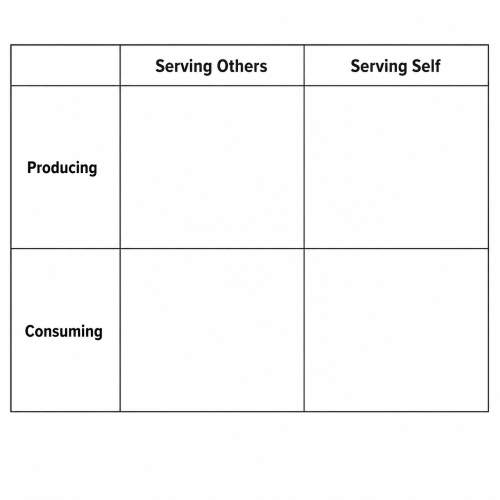
As I was chewing on this recently, I realized that these two ways of analyzing my time could be complimentary. Imagine a grid like this:
With this model, each box starts to make sense:
- Producing / Serving Others – This is anything you’re creating where someone else is the primary beneficiary. Examples: Making dinner, planning a family trip, doing yard work, creating a family budget, volunteering on the church council, or practicing piano for playing at church services. This box is where the vast majority of my time goes and I think that’s a good thing.
- Consuming / Serving Others – This quadrant doesn’t always feel productive in the moment but it can make your service more effective in the future. Examples: Reading a book about team leadership, learning a new technology, or studying the Bible to prepare to teach a Bible class. I don’t think I have a lot of regular tasks that fit in this quadrant.
- Producing / Serving Self – In this zone, you’re producing something where you are the primary beneficiary. Examples: Woodworking, personal finance planning, or organizing the garage. If I had no responsibilities, this is where I’d love to spend all my time. In reality, this box usually gets squished out by the producing/serving others box.
- Consuming / Serving Self – While there’s nothing inherently wrong with this quadrant, it’s the “candy”. Left unchecked, this can get out of hand. Examples: Watching TV, playing video games, or taking a nap. I do reserve some time at the end of the day to wind down with TV and reading a book. If I run fast right up until the point I crawl into bed, I don’t get very good sleep.
I think that whether you’re trying to lose weight, break a habit, or optimize your time, writing it all down is a great way to tackle the challenge. Seeing everything listed out at the end of the day or the week can be eye-opening. With something like this that is more subjective, you have to be very honest with yourself because not everything fits nicely into a single quadrant. For example, why am I blogging right now? I’m definitely producing content, but who does it serve? Some of it is recording content for my family to look back on in the future, some of it I think will be useful to others, and a lot of it is just me enjoying writing. Ultimately, if you have to say “well technically” before your answer, you probably already know which quadrant it should fit in.
I don’t think there’s any “right” answer about how your time gets divided among these four quadrants, but I do try to be intentional about it, and I pointedly focus on keeping the bottom right quadrant to the bare minimum. Social media and doom scrolling apps fall squarely in that bottom right quadrant, but that’s a topic for another post.




Is Crater Lake a National Park?
The short answer is, yes, Crater Lake is a National Park. But should it be?
There are many different designations that can be assigned by the federal government. The main choices for a place like Crater Lake would be park, monument, reserve, or preserve. The difference between the main two, park and monument, is that a park has a larger variety of resources and areas. A monument is more about a single significant resource and less diversity.
To put Crater Lake in context, think about Mt. St. Helens. That’s a national park, right? Nope. It’s a “national volcanic monument”.
I’m not saying that Crater Lake isn’t beautiful or that it shouldn’t be preserved. I’m glad it is federally protected forever! It’s fantastically blue and I’m glad we stopped there. But does it live up to the “national park” rating. I don’t think so. While I’m sure you could stretch to find other things to see besides the lake, that’s really the bulk of it. And yes, you can drive around to see it from different angles but how much does that really add to your experience?
The real reason why it’s a park and not a monument? It was designated as a park in 1902. The Antiquities Act didn’t come along until 1906 and that’s what created the “monument” category. It allows presidents to declare anything a national monument without going through a full legislative process.
I don’t want to sound like I’m bagging on Crater Lake too much, but there are a lot of national parks where you can easily spend a week exploring what they have to offer. I wouldn’t put Crater Lake in that tier.